 The Sourdough
 Troubleshooting
Overproofed vs Underproofed Sourdough: How to Tell (and the Poke Test)
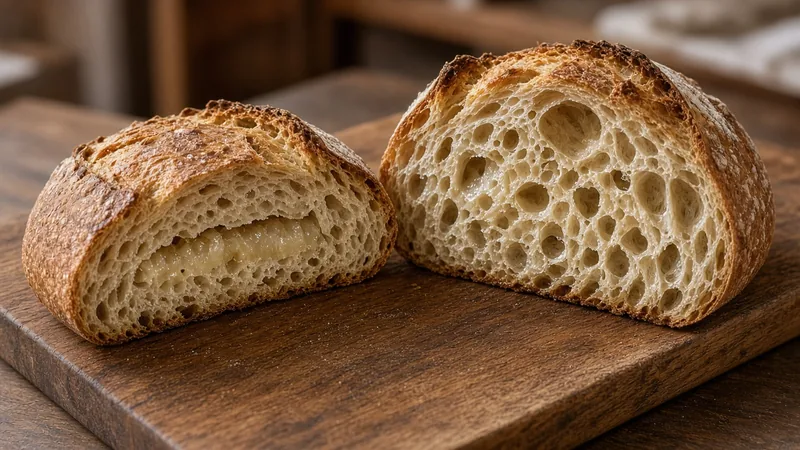
"Is it underproofed or overproofed?" is probably the most common question home sourdough bakers ask about a disappointing loaf. The two problems can look surprisingly similar from the outside: both can give a flat or dense loaf. The differences show up in how the dough behaves and in the crumb.
First, a quick word on terms. Bulk fermentation is the long rise after mixing. Proofing (or the final proof) is the rise after shaping. In everyday use, "underproofed" often means under-fermented overall, and most problems actually start in bulk.
Underproofed (under-fermented) dough
The dough simply hasn't fermented long enough. There isn't enough gas, and the gluten is still tight.
Signs in the dough:
- Little growth during bulk fermentation.
- Few bubbles on the surface or sides of the container.
- Feels tight and dense rather than airy and jiggly.
- On the poke test, springs back quickly.
Signs in the baked loaf:
- Tight, dense or gummy crumb, often with a few large, irregular holes near the top (sometimes called a "fool's crumb").
- A wild burst or tear along the score, because the loaf expands a lot in the oven.
- Sometimes a pale, shiny crust.
What to change: give bulk fermentation more time or a warmer spot, and make sure your starter is active when you use it. Our dense loaf guide covers this in more depth.
Overproofed (over-fermented) dough
The dough fermented for too long or too warm. The gluten has weakened and can't hold the gas any more.
Signs in the dough:
- Very slack, sticky and hard to shape.
- Large bubbles that pop easily; the surface may look deflated.
- Spreads out when turned out of the banneton.
- On the poke test, the dent stays and doesn't spring back, or the dough sags.
Signs in the baked loaf:
- Flat, wide loaf with little oven spring.
- The score barely opens.
- Crumb with lots of small, even holes, sometimes with a slightly collapsed or gummy look, and a stronger sour or boozy flavour.
What to change: shorten bulk fermentation or use a cooler spot, end bulk when the dough has risen about 50 to 75% rather than doubled (as a rough guide), and don't let the final proof run too long. A thermometer helps you see how warm your dough really is.
The poke test
The poke test is a quick way to judge the final proof. Lightly flour a finger and press it about 1 cm into the dough.
- Springs back quickly: probably underproofed. Give it more time.
- Springs back slowly and leaves a small dent: usually ready to bake.
- Doesn't spring back at all: probably overproofed. Bake it straight away.
The big caveat: cold dough. Dough straight from the fridge is firmer, so it tends to spring back faster even when it's ready. Many bakers find the poke test less useful after a cold proof. Instead, judge mainly by how the dough looked at the end of bulk fermentation, and by experience with your own schedule.
Can you rescue it?
- Underproofed: just give it more time, at room temperature if needed, before baking.
- Overproofed: bake it now. It may be flatter, but it's still bread. Very slack dough can also be pressed into an oiled tin and baked as a focaccia-style flatbread.
Frequently asked questions
Is it better to underproof or overproof sourdough?
Many bakers say a slight underproof is easier to live with than an overproof, because an underproofed loaf still has strong gluten and some oven spring. Ideally, aim for neither.
How long should sourdough proof?
It depends on temperature, flour and starter strength. At room temperature the final proof is often 1 to 3 hours; a cold proof in the fridge is often 8 to 16 hours. Watch the dough rather than the clock.