 The Sourdough
 Recipe
Basic Sourdough Bread Recipe for Beginners (With Baker's Percentages)
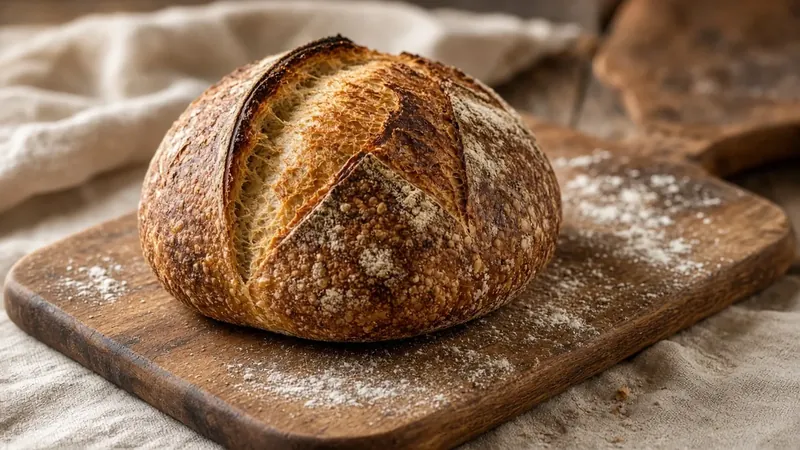
This is a plain, forgiving everyday loaf: mostly white bread flour with a little whole wheat, at a moderate 70% hydration that's easy to handle. It's the sort of formula many home bakers start with, and once you can bake it consistently it's a good base for experimenting.
Times below are a guide only. Your starter, flour and kitchen temperature decide the real schedule, so watch the dough, not the clock. If your loaves come out tight or gummy, our guide to why sourdough turns out dense walks through the usual causes.
What you need
- An active, bubbly sourdough starter (fed 4 to 12 hours earlier and roughly doubled). Starter sulking? See sourdough starter not rising.
- A digital kitchen scale: this recipe is in grams.
- A large bowl or straight-sided container, a bench scraper, a proofing basket or a bowl lined with a floured tea towel, and a lidded oven-safe pot such as a Dutch oven.
Ingredients and baker's percentages
In baker's percentages every ingredient is expressed relative to the total flour weight (flour = 100%). That makes it easy to scale the recipe or tweak one thing at a time.
| Ingredient | Weight | Baker's % |
|---|---|---|
| White bread flour | 450 g | 90% |
| Whole wheat flour | 50 g | 10% |
| Water (lukewarm, about 27°C / 80°F) | 350 g | 70% |
| Active starter (100% hydration) | 100 g | 20% |
| Fine salt | 10 g | 2% |
| Total dough | 960 g |
This makes one medium loaf. If your flour is lower in protein, or this is your first bake, you can hold back 25 g of the water and add it only if the dough feels stiff. A slightly lower hydration is easier to shape.
Timeline at a glance
An example schedule, assuming a kitchen around 24°C (75°F). Cooler kitchens take longer; warmer ones go faster.
| When | Step | Roughly how long |
|---|---|---|
| Day 1, 9:00 am | Feed your starter | 4 to 6 hours until bubbly and about doubled |
| 2:00 pm | Mix flour and water (autolyse) | 30 to 60 minutes rest |
| 3:00 pm | Add starter and salt | 5 to 10 minutes of mixing |
| 3:30 to 5:00 pm | Stretch and folds (4 sets, 30 minutes apart) | About 1.5 hours |
| 5:00 to about 8:00 pm | Rest of bulk fermentation | Until the dough has grown about 50 to 75% |
| About 8:00 pm | Pre-shape, rest, then final shape | About 30 to 45 minutes |
| Overnight | Cold proof in the fridge | About 10 to 16 hours |
| Day 2, morning | Preheat, score and bake | About 1 hour plus 45 minutes in the oven |
| After baking | Cool before slicing | At least 1 to 2 hours |
Step by step
- Feed your starter. Use it when it's bubbly, domed or just starting to flatten, and has roughly doubled. A starter that hasn't risen won't raise the loaf either.
- Autolyse. In a large bowl, mix the two flours with 330 g of the water until no dry flour remains. Cover and rest 30 to 60 minutes. This gives the flour time to absorb water and makes the dough easier to work.
- Add the starter and salt. Add the 100 g of starter, the 10 g of salt and the remaining 20 g of water. Squeeze and fold the dough with a wet hand for several minutes until everything is fully combined. It will feel shaggy at first and then come together.
- Stretch and folds. Every 30 minutes for the next couple of hours, do one set: with a wet hand, lift one side of the dough, stretch it up and fold it over, then turn the bowl and repeat on all four sides. Over the sets the dough should become smoother, stronger and less sticky.
- Finish bulk fermentation. Leave the dough covered until it has grown by roughly 50 to 75%, has a domed, slightly jiggly surface and shows some bubbles on the sides and top. A straight-sided container with a mark at the start level makes this much easier to judge. This step is the one most worth getting right: under-fermented dough is the most common reason for a dense loaf.
- Pre-shape. Tip the dough onto an unfloured counter and use a bench scraper to gently round it into a loose ball. Rest uncovered for 20 to 30 minutes.
- Shape. Lightly flour the top, flip it over and shape into a tight round (boule) or oval (batard), building surface tension without tearing the skin. Place it seam side up in a floured banneton or a bowl lined with a well-floured tea towel. Rice flour helps prevent sticking.
- Cold proof. Cover and refrigerate overnight, about 10 to 16 hours. The cold slows fermentation, develops flavour and makes the dough easier to score.
- Preheat. Put your lidded pot in the oven and preheat to 250°C (480°F) for 45 to 60 minutes.
- Score and bake. Turn the cold dough out onto parchment, score one confident cut about 1 cm deep with a lame or a very sharp blade, and lower it into the hot pot. Bake covered for 20 minutes, then remove the lid, reduce the heat to 230°C (450°F) and bake another 20 to 25 minutes until deeply browned. If you use a probe thermometer, the centre is usually around 96 to 99°C (205 to 210°F) when done.
- Cool. Let the loaf cool on a rack for at least 1 to 2 hours before cutting. The crumb keeps setting as it cools, and slicing early can make it seem gummy.
Frequently asked questions
Can I bake it the same day instead of overnight?
Yes. After shaping, proof at room temperature until the dough springs back slowly when poked, often 1 to 3 hours. The flavour will be milder and the dough a little harder to score.
My dough is very sticky. Did I do something wrong?
Sourdough at 70% hydration is meant to be tacky. Wet your hands rather than adding lots of flour, and let the stretch and folds build strength. If it's still unmanageable, use 25 g less water next time.
How do I make it more or less sour?
A longer, colder proof and a higher share of whole grain flour generally give a tangier loaf. Using the starter at its peak and a shorter cold proof tends to be milder.
How long does it take to make sourdough bread?
With an overnight cold proof, plan for about 24 hours from feeding your starter to a cooled loaf, though only around 30 to 60 minutes of that is hands-on work. A same-day bake is possible but leaves less flexibility.
Can you make sourdough without a starter?
Not true sourdough, because the starter is what leavens it. You can make a starter from just flour and water (see how to make a sourdough starter), or get some from another baker. Recipes that add vinegar or commercial yeast make a different kind of bread.
Can you make sourdough in a bread machine?
Some bread machines have programmes long enough for sourdough, but many standard cycles are too short for a natural starter to raise the dough. A common approach is to mix in the machine and then ferment, shape and bake by hand.
Next steps
Once this loaf works for you, change one thing at a time, for example 20% whole wheat, or 72 to 75% water, and note what happens. When something goes wrong, our troubleshooting hub is the place to start.