 The Sourdough
 Getting Started
How to Make a Sourdough Starter From Scratch (Day-by-Day Guide)
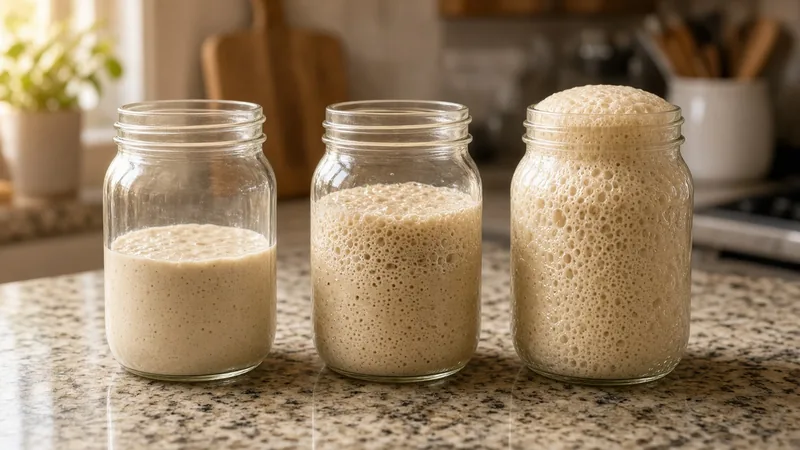
A sourdough starter is just flour and water that has been fed regularly until wild yeast and lactic acid bacteria settle in and multiply. It's the leavening in sourdough bread, and you can make one at home with nothing more than a jar, a scale, flour and water.
It isn't hard, but it does take patience. Most starters take somewhere around one to two weeks before they're reliably strong enough to bake with, and the timing depends heavily on your flour and how warm your kitchen is.
What you need
- A clean glass jar of roughly 500 ml to 1 litre, ideally straight-sided so you can see the rise. A loose lid or a cloth on top is fine. (More on jars in our starter kit guide.)
- A digital kitchen scale. Weighing makes the ratios consistent.
- Flour. Whole wheat or rye is a good choice for the first few days, because whole grains tend to get things going faster. You can switch to mostly white bread flour later.
- Water. Tap water is usually fine. If yours is heavily chlorinated, let it stand uncovered for a few hours or use filtered water.
- A rubber band or marker to mark the level after each feed.
The day-by-day schedule
This is a simple, common method. The amounts are small to keep waste down.
| Day | What to do |
|---|---|
| 1 | Mix 50 g whole wheat or rye flour with 50 g water. Cover loosely and leave somewhere warm, ideally 24 to 27°C (75 to 80°F). |
| 2 | You may see a few bubbles, or nothing. Either is normal. Leave it alone, or just stir. |
| 3 to 4 | Keep 50 g of the mixture and discard the rest. Feed it 50 g flour and 50 g water once a day. It may suddenly bubble up, then seem to go quiet. |
| 5 to 7 | Keep feeding once a day (50 g starter, 50 g flour, 50 g water). You can start using half white bread flour. When it starts rising within about 12 hours, move to twice-a-day feeds. |
| Week 2 | Feed every 12 hours. Look for a predictable rise and fall, a pleasant sour smell and plenty of bubbles. |
The 50 : 50 : 50 feed is a 1:1:1 ratio (starter : flour : water by weight). Once it's strong you can use larger feeds, such as 1:2:2 or 1:5:5, to slow it down if it peaks too fast.
The quiet phase is normal
Around days 3 to 6 many new starters bubble enthusiastically and then appear to die. This is widely reported by home bakers and is usually not a failure: the early bubbles often come from bacteria that are not the ones you want long term, and the mixture becomes more acidic as the yeast and lactic acid bacteria take over. Keep feeding on schedule, keep it warm, and give it a few more days before starting again.
If it's still doing nothing after two weeks, see our starter not rising guide.
How to tell when it's ready to bake with
A starter is generally ready when, for several days in a row:
- It roughly doubles within about 4 to 8 hours of a feed at warm room temperature.
- It's full of bubbles all through, not just on top.
- It smells pleasantly sour or yeasty, like yogurt or beer.
- The rise is predictable from one feed to the next.
The float test (dropping a spoonful into water to see if it floats) is popular, but it isn't fully reliable, especially with wetter or whole grain starters. The rise is a better guide.
Keeping your starter
- Baking often: keep it on the counter and feed it once or twice a day.
- Baking weekly: many bakers keep it in the fridge and feed it once a week, then give it one or two feeds at room temperature before baking.
- Discard: the starter you remove when feeding is called discard. Rather than throwing it out, try our sourdough discard recipes.
Common problems
- Liquid on top (hooch): it's hungry. Stir it in or pour it off, and feed it.
- Nail-polish or sharp vinegar smell: also usually a sign of hunger. Feed it more often or with a larger feed.
- Mould: pink or orange streaks or fuzzy patches mean it's best to throw it out and start again with a clean jar.
- Slow in a cold kitchen: find a warmer spot, such as near (not on) a heat source, or in the oven with only the light on. Check the temperature with a thermometer. A proofing box is a more controllable option.
Frequently asked questions
Can I use all-purpose or white flour to make a starter?
Yes, but starters made with only white flour are often slower to get going. Starting with whole wheat or rye and switching to mostly white flour later is a common compromise.
Do I have to throw away part of my starter each time?
Discarding keeps the amount manageable and keeps the ratio of food to starter high enough. You don't have to waste it: discard can go into pancakes, crackers and other recipes.
Can I make a starter with pineapple juice, grapes or yeast?
Some methods use pineapple juice in the first few days to make the mixture more acidic. It isn't necessary, and flour and water alone work for most bakers. Adding commercial yeast gives you a yeasted dough, not a sourdough starter.
What should I name my sourdough starter?
Whatever you like. Naming starters is a popular tradition, and it doesn't affect how it behaves.